Greece · Textiles / Handloom Pattern Weaving
Cretan Xobliasta Loom-Patterned Weaving
Ξομπλιαστά υφαντά (xobliasta)
Cretan xobliasta weavers build geometric motifs into a textile as it is woven. They insert short lengths of colored weft by hand, counting warp threads to set the width and position of each color area, while weaving the ground with a shuttle.
Risk level: Vulnerable ·
- Geographic Center
- Crete, Greece, with regional variations
- Community / Ethnic Group
- Cretan textile weavers
- Primary Materials
- Colored pattern weft and ground warp and weft. Museum examples include wool warp and a cotton connecting weft. Confirm the fibers of each cataloged object individually.
- Primary Tools
- Handloom and shuttle for the ground. Colored weft is prepared in small skeins for hand insertion.
- Process Overview
- Weave the ground with a shuttle and build the motifs by inserting short colored wefts across counted groups of warps. Work adjacent colors separately or intermesh the wefts where a long boundary needs a continuous join.
- Traditional Applications
- Geometric woven decoration appears on Cretan bedspreads, wall hangings and sofa covers, and on work items such as saddlecloths and shepherds’ bags. These examples describe the broader regional textile tradition. Source: Museum of Cretan Ethnology, Woven fabrics with geometrical decoration.
- Contemporary Applications
- The Museum of Cretan Ethnology documents xobliasta as patterned decoration worked into the fabric at the loom. As a contemporary regional comparison, Klothó in Rethymno uses Cretan handloom weaving and embroidery for homeware and clothing. Its public process description does not identify xobliasta specifically. Sources: Museum of Cretan Ethnology and Klothó.
- Notable Practitioners
- Named practitioners for this exact weaving method remain to be verified.
- Key References
- https://www.cretanethnologymuseum.gr/woven-fabricks-with-geometrical-decoration/ | https://www.craeft.eu/wp-content/uploads/2025/04/D1.2_v8_total.pdf | https://www.craeft.eu/wp-content/uploads/2025/04/D1.1_V2_2.pdf | https://zenodo.org/records/14698676 | https://klotho.com.gr/how-our-clothes-are-made/ | https://klotho.com.gr/our-studio/ | https://www.chania-heritage.gr/en/heritage/weaver/ | https://archanon-asterousion.gr/παράδοση-και-ιστορία/
- Verification Status
- Desk-Researched — Needs Practitioner Verification
CRAFT DOCUMENTATION LAB · PILOT 01 · CRAFT-3089
Explore the Craft Process
Cretan Xobliasta Weaving. Explore the proposed sequence of operations and the relationships between making, embodied knowledge and documentary evidence.
Research prototype · Documented observations and provisional interpretations are distinguished under Evidence
ACTIVITY 01 / 05
Prepare loom
Prepare loom.
Critical judgment
Assess the loom setup and suitability of the prepared yarns for the intended textile.
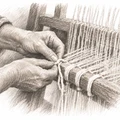
CRAEFT D1.1 pp. 56, 70–71, 82 describes xobliasta colored-weft counting and reuse of Mingei archival data; this five-step grouping remains editorial, not a verified video segmentation.
More from Greece
- Cretan Pottery (Thrapsano and Margarites)Ceramics & Pottery · Endangered
Thrapsano and Margarites are pottery centers in Crete.
- Cretan Tsikoudia (Raki Distilling)Food, Drink & Botanical · Stable
The Cretan tsikoudia (raki) distilling tradition — the production of the traditional Cretan grape pomace distillate made annually from the grape skins and seeds remaining after wine pressing, whose specific Cretan character (lighter and…
- Chrysokentima (Gold Ecclesiastical Embroidery)Embroidery & Lace · Vulnerable
The Greek chrysokentima (gold embroidery) tradition — the production of the characteristic Greek Orthodox ecclesiastical vestments (epitaphioi, epitrachelia, and other liturgical textiles) embroidered with gold and silver threads in the…
- Metsovo Woodcarving (Epirus)Woodwork & Carving · Vulnerable
The Metsovo woodcarving tradition of the Pindus mountains — the production of the distinctive Epirus folk carved wooden objects (furniture elements, household implements, decorative objects) from the walnut and chestnut trees of the Pindus…
- Olive Oil (Kalamata PDO)Food, Drink & Botanical · Stable
The Greek olive oil production tradition — Greece produces the highest percentage of extra virgin olive oil of any country in the world, with the Kalamata PDO region of the Peloponnese producing the most internationally recognized Greek…
- Feta Cheese (PDO Sheep Milk)Food, Drink & Botanical · Stable
The Greek feta cheese making tradition — the production of the PDO-protected white brined cheese from sheep milk (minimum 70%) and goat milk (maximum 30%) in the specific Greek geographic zones (mainland and Lesvos), whose characteristic…
Related weaving & textiles elsewhere
- Masatepe Wooden Rocking Chair MakingNicaragua · Stable
The hand-crafting of Nicaragua's iconic rocking chair — a wooden frame, traditionally in hardwoods such as mahogany, cedar, or teak, joined and shaped by hand, then fitted with a hand-woven cord or rope seat and back — centered on the town…
- Lampung Tapis WeavingIndonesia · Endangered
Tapis is the ceremonial woven and embroidered cloth of the Lampung people of southernmost Sumatra — one of the most technically complex textiles in Indonesia, combining handwoven cotton ground with supplementary weft patterning, embroidery…
- Patan PatolaIndia · Critically Endangered
Patan Patola is the third and most technically demanding double-ikat tradition documented in the CRAFT database (alongside Odisha Bandha, CRAFT-0064, and Pochampally Ikat, CRAFT-0084).
- Tenun Siak WeavingIndonesia · Endangered
Tenun Siak is the traditional Malay weaving tradition of the Siak Sultanate area in Riau province — producing supplementary weft patterned silk cloth in a palette and motif vocabulary reflecting Riau's Malay Islamic cultural identity and…
- Mata ni PachediIndia · Critically Endangered
Mata ni Pachedi (Gujarati: 'cloth behind the mother goddess') is a hand-drawn and block-printed narrative textile tradition of the Vaghari community of Ahmedabad, Gujarat.
- Pua Kumbu Ikat WeavingIndonesia · Critically Endangered
Pua Kumbu is the sacred warp ikat cloth of the Iban Dayak people — one of the most powerful ritual textiles in Borneo and among the most technically and spiritually complex in Southeast Asia.