Greece · Ceramic arts; Folk pottery; Greek heritage
Cretan Pottery (Thrapsano and Margarites)
Κρητική Κεραμική — Θραψανό και Μαργαρίτες
Thrapsano and Margarites are pottery centers in Crete. In Thrapsano, a workshop documents building large storage jars in successive sections. In Margarites, CRAEFT studied preparation of clay from raw soil and pottery practice with the Keramion workshop.
Risk level: Endangered · Not listed; on Greek national heritage inventory
- Alternate Names
- Κρητική κεραμική; Cretan pottery; Θραψανό; Μαργαρίτες; pithoi; Cretan jar; storage jar; τζάρα; κεραμιστής
- Geographic Center
- Thrapsano village, Heraklion, Crete — the primary Cretan large-vessel pottery center; Margarites village, Rethymno, Crete — the second Cretan pottery center; the Archaeological Museum of Heraklion Minoan πίθοι collection
- Community / Ethnic Group
- Greek / Cretan
- Estimated Origin
- Crete has ancient ceramic precedents, including large Minoan storage jars. The CRAEFT study includes modern experiments informed by archaeology. A continuous transmission path from the Bronze Age has not been established here.
- Cultural Function
- Cretan potters make domestic earthenware and large storage vessels. In Margarites, workshop research also uses archaeological evidence to explore earlier vessel forms and methods.
- Primary Materials
- Cretan earthenware clays. In Margarites, the observed practitioner uses clay made from local earth from Aori, at the foot of Psiloritis. Source: CRAEFT D1.2, Margarites workshop account.
- Primary Tools
- Potter’s wheel and kiln. Keramion documents local clay and wood firing. Houlakis documents an electrically driven wheel for its Thrapsano large-vessel production.
- Process Overview
- Prepare clay, form the vessel, dry it and fire it. A Thrapsano workshop builds pitharia in successive wheel-formed sections. CRAEFT’s Margarites case documents making clay from raw soil and forming pottery at Keramion.
- Traditional Applications
- Large pitharia for storage and domestic earthenware.
- Contemporary Applications
- In Thrapsano, Konstantinos Houlakis offers Cretan jars, vases and decorative ceramics. In Margarites, Keramion demonstrates local-clay pottery and uses it in workshops and archaeological reconstruction. These are separately documented applications. Sources: Houlakis product catalog and CRAEFT D1.2.
- Notable Practitioners
- Giorgis Dalamvelas, potter and instructor at Keramion, is documented for Margarites. Mariniki Mania is credited as an archaeological conservator and workshop collaborator. Houlakis Pottery Art provides a separately documented Thrapsano workshop example.
- Key References
- Κρητική Κεραμική (Thrapsano tradition; Archaeological Museum of Heraklion) | https://www.craeft.eu/wp-content/uploads/2025/04/D1.1_V2_2.pdf | https://www.craeft.eu/wp-content/uploads/2025/04/D1.2_v8_total.pdf | https://www.pottery-art.gr/en/production/production.html | https://www.minoanpottery.gr/en/shop/
- Verification Status
- Desk-verified for the two documented workshop examples. Practitioner verification pending for sensory and timing details.
CRAFT DOCUMENTATION LAB · PILOT 01 · CRAFT-1574
Explore the Craft Process
Cretan Pottery. Explore the proposed sequence of operations and the relationships between making, embodied knowledge and documentary evidence.
Research prototype · Documented observations and provisional interpretations are distinguished under Evidence
ACTIVITY 01 / 05
Center clay
Center clay.
Critical judgment
Feel whether the clay rotates evenly enough to open without wobbling.
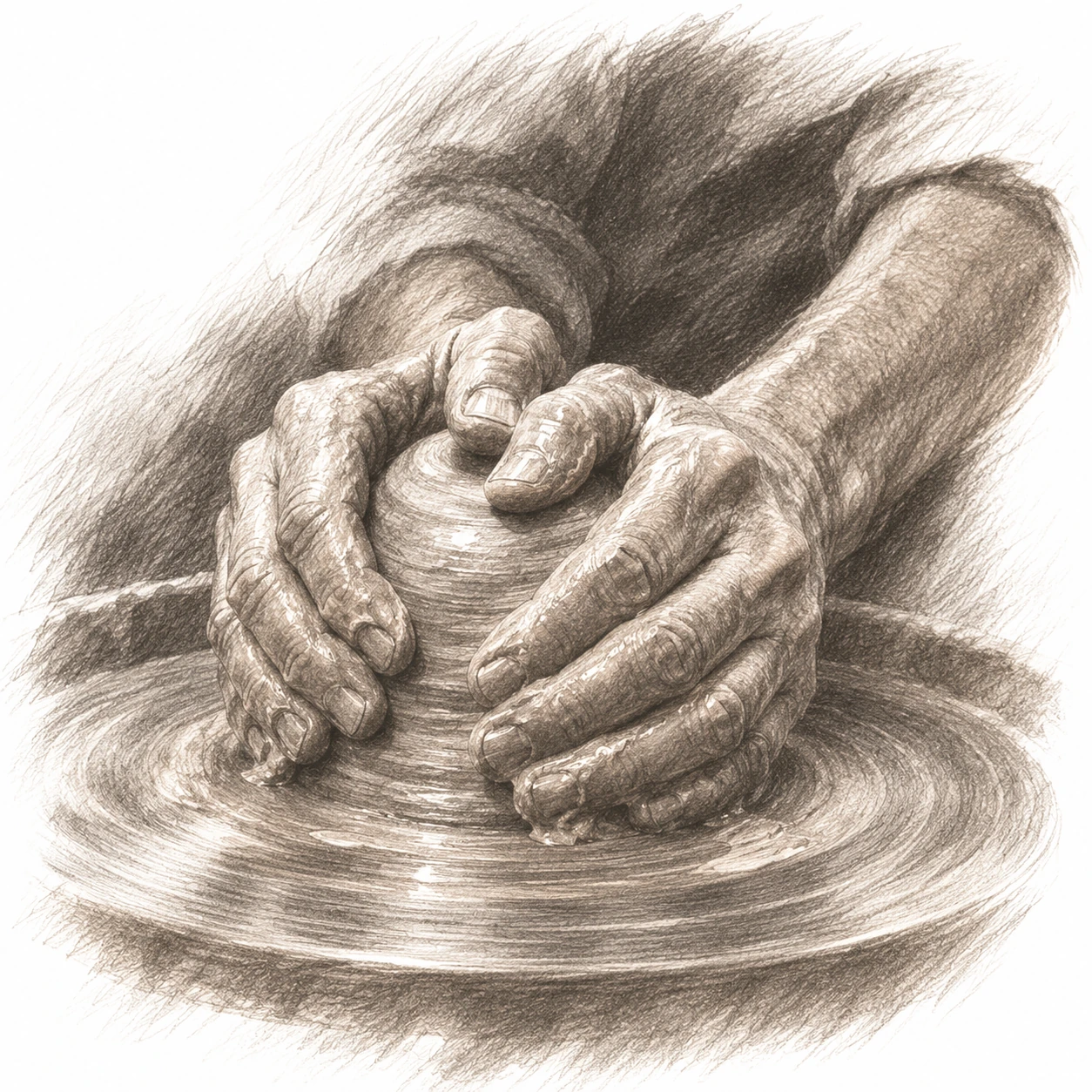
CRAEFT D1.1 p. 69 enumerates five bowl-related operations but lists lifting before final shaping. This display follows the physically coherent throwing sequence; the precise Margarites video chronology is not independently timestamp-verified. Do not conflate this demonstration with Thrapsano pithari pottery.
More from Greece
- Cretan Xobliasta Loom-Patterned WeavingWeaving & Textiles · Vulnerable
Cretan xobliasta weavers build geometric motifs into a textile as it is woven.
- Cretan Weaving (Rethymno Kilim)Weaving & Textiles · Stable
The Cretan weaving tradition — the production of the distinctive Cretan flat-woven floor coverings and wall hangings whose characteristic deep red, dark blue, and black geometric vocabulary on natural wool creates the most recognisable…
- Skyros Painted Furniture (Greek Island Decorative)Painting & Decorative Arts · Endangered
The Skyros painted furniture tradition — the distinctive Greek island folk decorative painting of the Sporades island of Skyros, whose characteristic style of covering every surface of the traditional Skyrian house interior (furniture,…
- Cretan Tsikoudia (Raki Distilling)Food, Drink & Botanical · Stable
The Cretan tsikoudia (raki) distilling tradition — the production of the traditional Cretan grape pomace distillate made annually from the grape skins and seeds remaining after wine pressing, whose specific Cretan character (lighter and…
- Metsovo Woodcarving (Epirus)Woodwork & Carving · Vulnerable
The Metsovo woodcarving tradition of the Pindus mountains — the production of the distinctive Epirus folk carved wooden objects (furniture elements, household implements, decorative objects) from the walnut and chestnut trees of the Pindus…
- Chrysokentima (Gold Ecclesiastical Embroidery)Embroidery & Lace · Vulnerable
The Greek chrysokentima (gold embroidery) tradition — the production of the characteristic Greek Orthodox ecclesiastical vestments (epitaphioi, epitrachelia, and other liturgical textiles) embroidered with gold and silver threads in the…
Related ceramics & pottery elsewhere
- Blue Pottery of JaipurIndia · Critically Endangered
Jaipur Blue Pottery is a unique ceramic tradition that is technically not pottery at all — it uses no clay.
- Shaoxing Wine Jar Making (Sha Gang)China · Endangered
The Shaoxing sha gang (沙缸 — sand jar) is the traditional ceramic fermentation and storage vessel for Shaoxing huangjiu (绍兴黄酒 — yellow rice wine), one of China's oldest fermented beverages with a 2,500-year documented history.
- Longquan Celadon (Qingci)China · Endangered
Longquan celadon is a jade-green glazed stoneware tradition from Longquan city, Zhejiang province — inscribed on UNESCO's Representative List in 2009 and considered one of the supreme achievements in world ceramics.
- Vallauris PotteryFrance · Vulnerable
Earthenware pottery from Vallauris — the Côte d'Azur town that was a medieval pottery center and became globally famous when Picasso worked there from 1947 to 1955, transforming the local craft industry.
- Yixing Zisha Teapot Making (Zisha Hu)China · Endangered
Yixing zisha (宜兴紫砂壶) is one of the most distinctive ceramic traditions in the world — producing unglazed stoneware teapots from a unique iron-rich purple-red clay found only in Yixing, Jiangsu, that absorbs tea oils over years of use to…
- Quimper Faience PotteryFrance · Vulnerable
Freehand-painted earthenware with opaque tin glaze, decorated with Breton peasant figures and quimperoise floral borders.