France · Glasswork / Hot Glassblowing
Rotating Mold Glassblowing for Tumblers
Soufflé tourné au moule (gobelet)
In rotating mold glassblowing (soufflé tourné), the observed practitioner inflates a hot glass bubble and rotates it inside the mold to shape a flat-bottomed tumbler. CRAEFT documented the process at CERFAV in Vannes-le-Châtel.
Risk level: Stable ·
- Alternate Names
- Soufflé tourné; turn-mold glassblowing; mold-blown gobelet; Vannes-le-Châtel glassblowing; Nancy-area glassblowing (CRAEFT case study)
- Geographic Center
- CERFAV, Vannes-le-Châtel, Meurthe-et-Moselle, France
- Primary Materials
- Molten glass. The batch composition used in the documented session is unverified.
- Primary Tools
- Gathering furnace and steel blowpipe for collecting and inflating the glass; shaping block for rounding the gather; mold for forming the body; diamond shears for chilling the break-off line; reheating furnace and punty for transfer and rim work. Source: CRAEFT recording session.
- Process Overview
- Gather and block the hot glass, start the bubble, blow and rotate inside the mold, then remove and reheat the tumbler before transferring it to a punty and opening the rim.
- Traditional Applications
- Turn molds were used to make drinking vessels. The Toledo Museum of Art catalogs a colorless, nonlead tumbler blown in a turn mold in Germany or Bohemia, probably between 1865 and 1900. It also catalogs an early American tumbler whose base and lower section were formed in a plain metal turn mold before the upper portion was expanded and finished with tools. These objects document historical applications beyond the French workshop case. Source: Toledo Museum of Art, objects 1913.542 and 1959.82.
- Contemporary Applications
- The technique is used for studio drinkware and vocational training. JFR Glass documents shaping a signature rocks glass in a hand-carved wooden turn mold soaked with water, then transferring the vessel to a pontil and opening the rim with steel tools. At CERFAV, CRAEFT documented the mold-blown tumbler as an apprentice exercise. Sources: JFR Glass, How It’s Made, and CRAEFT recording session.
- Notable Practitioners
- Maxime Rosseel, CERFAV-trained glassblower and then head of its public workshops, demonstrated the mold-blown gobelet. Arnaud Dubois, CNAM anthropologist, helped document the work. Source: CRAEFT recording session.
- Key References
- https://www.craeft.eu/representative-craft-instances/rci1-glass/recording-session/ | https://www.craeft.eu/wp-content/uploads/2025/04/D1.1_V2_2.pdf | https://www.craeft.eu/wp-content/uploads/2025/04/D1.2_v8_total.pdf | https://www.craeft.eu/wp-content/uploads/2025/04/D6.1-EducationAndTraining-20250212_xz.pdf | https://cerfav.fr/culture/boutique-vannes-le-chatel/ | https://zenodo.org/records/14205867 | https://zenodo.org/records/14195940 | https://www.craeft.eu/wp-content/uploads/2025/04/D1.1_v7.pdf | https://www.craeft.eu/wp-content/uploads/2024/03/Julia-Schaff-Cerfav-1024x771.jpg | https://allaboutglass.cmog.org/definition/mold-blowing | https://sha.org/bottle/pdffiles/DSGCo.pdf | https://cerfav.fr/faq/ | https://www.mdpi.com/2813-2084/5/2/26 | https://emuseum.toledomuseum.org/objects/53136/tumbler | https://emuseum.toledomuseum.org/objects/53764/tumbler | https://jfrglass.com/pages/copy-of-how-its-made | https://jfrglass.com/collections/rocks-glasses | https://jfrglass.com/pages/contact
- Verification Status
- Desk-Researched — Needs Practitioner Verification
CRAFT DOCUMENTATION LAB · PILOT 01 · CRAFT-3088
Explore the Craft Process
Rotating mold glassblowing for tumblers, documented by CRAEFT at CERFAV. Explore the six recorded operations and their relationships to tools, gestures, judgments and evidence.
Research prototype · Source-reconstructed from the CRAFT record · Desk-researched, awaiting practitioner verification
ACTIVITY 01 / 06
Gather hot glass
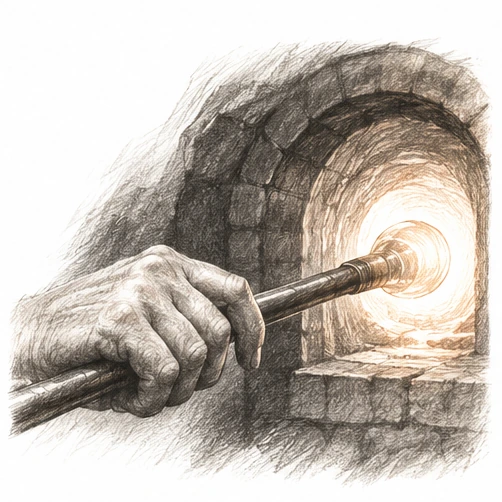
Gather molten glass onto the steel blowpipe.
Critical judgment
Assess the size and consistency of the gather while controlling how much molten glass adheres to the blowpipe.
This pilot is specific to CRAFT-3088. It does not alter other technique records or imply permission to reproduce CRAEFT media.
More from France
- Lyon Mise en CarteWeaving & Textiles · Endangered
The mise en carte is the translation of a textile designer's painted design into a Jacquard program — historically by hand-drawing each thread intersection onto squared paper (papier à la mise en carte) and then punching each card hole by…
- Lyon Silk DyeingDyeing & Surface Design · Vulnerable
The dyeing of silk yarn and fabric in Lyon — a tradition as old as the weaving itself, carried out in the teintureries of the Croix-Rousse and riverside workshops.
- Lyon Silk Ribbon WeavingWeaving & Textiles · Vulnerable
The weaving of silk ribbon — narrow silk fabric (2–150mm wide) on specialized ribbon looms in Saint-Étienne, historically the ribbon capital of France.
- Lyon PassementerieWeaving & Textiles · Endangered
The making of silk trimmings — fringes (franges); tassels (glands); braid (galon); cord (cordon); and passements (decorative trimming elements) — in the Lyon tradition.
- Lyon Silk WarpingWeaving & Textiles · Vulnerable
The preparation of silk warp on the ourdissoir (warping drum or frame) before threading the loom — the first step in producing Lyon silk fabric.
- Bordeaux Wine CooperageWoodwork & Carving · Stable
The making of the barrique bordelaise — the 225-litre French oak barrel that is the global standard for fine wine aging, named after its Bordeaux origin.
Related glasswork elsewhere
- Al-Aqsa Qamariyyah Gypsum Stained-Glass Window MakingPalestine · Endangered
The sculpting of gypsum, wood, plaster (stucco), and stained glass into qamariyyahs (skylights) and shamsiyyahs (windows) for the Al-Aqsa Mosque and the Dome of the Rock, within the 144-acre Haram al-Sharif compound in Jerusalem's Old…
- York Minster Stained Glass ConservationUnited Kingdom · Stable
The conservation of the York Minster stained glass — specifically the Great East Window (1405–1408, by John Thornton of Coventry), the largest expanse of medieval stained glass in England and arguably the most ambitious single stained…
- Architectural Stained Glass Windows (Montevideo)Uruguay · Critically Endangered
Leaded stained-glass windows for buildings, which in Montevideo flourished in a documented boom of 1920–1940, when a prosperous city favored interior courtyards crowned with glass.
- Carved Wood and Stained Glass Combined SculptureUruguay · Vulnerable
Figurative wood carving combined with leaded stained glass set into the carved wood itself: a robed standing figure with a glass heart inset in its chest, animal and figurative forms with cavities filled with colored glass, alongside…
- Mallorca Artificial Pearl MakingSpain · Stable
The making of artificial pearls in Manacor, Mallorca — a tradition invented in 1890 by Eduard Hugo Heusch and developed into a world-renowned craft industry.
- Sarafand Khalifeh Family Recycled-Glass BlowingLebanon · Critically Endangered
The hand-blowing of glass objects by the Khalifeh family, in Sarafand, South Lebanon, directly documented as the last remaining traditional glassblowing operation in the entire country -- a severe, precisely quantified decline from the…